



How to ensure employer health plans meet ACA affordability?
For over 15 years in the intricate world of insurance and benefits, I've seen countless businesses, from burgeoning startups to established enterprises, grapple with the complexities of the Affordable Care Act (ACA). One particular area consistently causes headaches: ensuring employer-sponsored health plans meet ACA affordability standards. It's not just a matter of checking a box; it's about navigating a labyrinth of regulations while striving to provide meaningful benefits to your team.
The stakes are incredibly high. Misinterpreting the rules can lead to significant financial penalties – known as Employer Shared Responsibility Payments (ESRPs) – and, perhaps more importantly, erode employee trust and morale. Many employers feel caught between the desire to offer robust, competitive benefits and the daunting task of deciphering the ever-evolving ACA guidelines. The challenge isn't just about the numbers; it's about understanding the spirit of the law and applying it practically within your organization.
That's precisely why I've distilled my years of experience into this definitive guide. You'll learn not just the 'what' but the 'how' – actionable frameworks, real-world case studies, and expert insights designed to empower you to confidently ensure your employer health plans meet ACA affordability. My goal is to equip you with the knowledge and tools to navigate these waters with confidence, protecting your business and valuing your employees.
Understanding the Core: What is ACA Affordability?
At its heart, ACA affordability is about ensuring that the cost of employer-sponsored health coverage is not excessive for employees. Specifically, for Applicable Large Employers (ALEs) – those with 50 or more full-time equivalent employees – the ACA mandates that they offer Minimum Essential Coverage (MEC) that provides Minimum Value (MV) to at least 95% of their full-time employees and their dependents. Crucially, this coverage must be 'affordable' to the employee.
The affordability threshold is a percentage of an employee's household income. For 2024, an employee's required contribution for the lowest-cost, self-only MEC plan offered by the employer cannot exceed 8.39% of their household income. Since employers generally don't know an employee's household income, the IRS provides three 'safe harbors' that allow employers to determine affordability based on information they do possess.
The cornerstone of ACA affordability compliance isn't just about offering coverage, but ensuring that the employee's share of the premium for self-only coverage is genuinely within reach, preventing significant financial burden.
It's important to differentiate between MEC and MV. Minimum Essential Coverage refers to health insurance that meets the ACA's basic requirements, such as most employer-sponsored plans. Minimum Value means the plan covers at least 60% of the total allowed cost of benefits and includes substantial coverage of physician and inpatient hospital services. Both are critical for compliance, but affordability specifically focuses on the employee's contribution for the lowest-cost, self-only MEC plan that meets MV.
The Three Safe Harbors: Your Path to Compliance
Because employers cannot reasonably know an employee's household income, the IRS established three affordability safe harbors. If an employer meets one of these safe harbors for an employee, the offer of coverage is considered affordable, even if the employee's actual household income would suggest otherwise. Choosing the right safe harbor is a strategic decision that can simplify compliance.
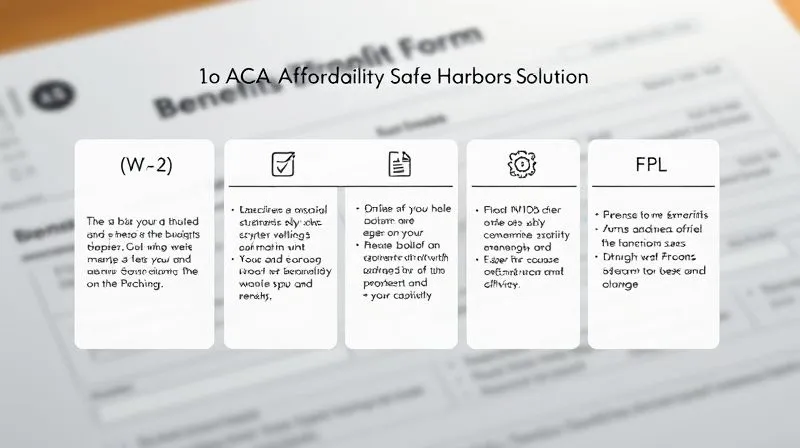
1. The W-2 Wages Safe Harbor
This safe harbor allows you to determine affordability based on the employee's Box 1 W-2 wages from your company for the calendar year. The employee's required contribution for the lowest-cost, self-only MEC plan must not exceed the affordability percentage of their W-2 wages. This is often the simplest safe harbor to apply, as W-2 wages are readily available.
- Pros: Straightforward calculation, uses existing payroll data.
- Cons: Can be problematic for employees with significant fluctuations in pay (e.g., commissions, bonuses) or those who don't work a full year, as their W-2 wages might be lower than their actual annual income, potentially making the plan appear unaffordable.
2. The Rate of Pay Safe Harbor
This safe harbor is particularly useful for hourly employees. For hourly workers, you multiply their lowest hourly rate of pay during the calendar month by 130 hours per month (the ACA's definition of full-time for a month). For salaried employees, you use their monthly salary. The employee's required contribution for the lowest-cost, self-only MEC plan must not exceed the affordability percentage of this calculated monthly wage.
- Pros: Offers predictability for hourly employees, less affected by fluctuations in actual hours worked beyond 130.
- Cons: Requires careful tracking of the lowest hourly rate for the month; for salaried employees, it's very similar to the W-2 method.
3. The Federal Poverty Line (FPL) Safe Harbor
Under this safe harbor, an offer of coverage is affordable if the employee's required contribution for the lowest-cost, self-only MEC plan does not exceed the affordability percentage of the federal poverty line for a single individual. This is often the most generous safe harbor for employees, as the FPL typically remains consistent throughout the year and is a known figure, regardless of an employee's actual earnings.
- Pros: Simplest to administer because the FPL is a fixed, published amount; often results in lower employee contributions, enhancing employee satisfaction.
- Cons: May require a higher employer subsidy to meet the lower FPL threshold, potentially increasing costs.
Calculating Affordability: Step-by-Step Guidance
Once you understand the safe harbors, the next step is to apply them to your workforce. This process requires careful data collection and calculation. I've found that a methodical approach is key to avoiding errors and ensuring consistent compliance.
- Identify All Full-Time Employees and Dependents: The ACA defines a full-time employee as one who works, on average, at least 30 hours per week or 130 hours per month. For variable-hour employees, you'll need to use a look-back measurement period (more on this later). Remember, the offer of coverage must extend to dependents (children under 26), although the affordability calculation only applies to the employee's self-only premium.
- Determine the Lowest-Cost, Self-Only MEC Plan Premium: For each full-time employee, identify the premium they would pay for the least expensive health plan offered by your company that provides Minimum Essential Coverage and meets Minimum Value, for self-only coverage. This is your baseline cost for affordability testing.
-
Select and Apply the Chosen Safe Harbor: Decide which safe harbor (W-2, Rate of Pay, or FPL) you will use. You can use different safe harbors for different classes of employees (e.g., hourly vs. salaried), but for consistency and administrative ease, many employers choose one primary safe harbor.
- W-2 Safe Harbor: Multiply the employee's W-2 wages from your company for the calendar year by the current affordability percentage (e.g., 8.39% for 2024).
- Rate of Pay Safe Harbor: For hourly employees, multiply their lowest hourly rate of pay for the month by 130 hours, then multiply by the affordability percentage. For salaried employees, use their monthly salary multiplied by the affordability percentage.
- FPL Safe Harbor: Use the current federal poverty line for a single individual (e.g., $14,580 for 2023, applicable for 2024 plan years) divided by 12 months, then multiply by the affordability percentage.
- Compare Employee Contribution to Affordability Threshold: Compare the employee's required contribution (from step 2) with the calculated affordability threshold (from step 3). If the employee's contribution is less than or equal to the threshold, the coverage is considered affordable for that employee. If it's higher, the coverage is not affordable, and you risk an ESRP if that employee then receives a premium tax credit for coverage purchased on a Health Insurance Marketplace.
This process must be performed for each full-time employee to ensure comprehensive compliance. Many employers find that leveraging robust HRIS or payroll systems can automate much of this data collection and calculation, significantly reducing administrative burden and potential for error.
| Safe Harbor | Calculation Basis | Pros | Cons | Example (2024) |
|---|---|---|---|---|
| W-2 Wages | Employee's W-2 wages from employer | Uses readily available data | Fluctuating pay can cause issues | $40,000 W-2 * 8.39% = $3,356 annual limit |
| Rate of Pay | Lowest hourly rate * 130 hours/month or monthly salary | Predictable for hourly; good for new hires | Requires careful tracking of lowest rate | $15/hour * 130 hrs/month * 8.39% = $163.60 monthly limit |
| Federal Poverty Line (FPL) | Annual FPL for single individual / 12 months | Simplest to administer, most generous | May require higher employer subsidy | ($14,580 FPL / 12) * 8.39% = $101.95 monthly limit |
Beyond the Numbers: Strategic Considerations for ALEs
While the calculations are critical, true ACA affordability compliance extends beyond mere arithmetic. It involves strategic planning, meticulous documentation, and a deep understanding of your workforce dynamics. As an experienced specialist, I've observed that the most successful companies integrate ACA compliance into their broader benefits strategy, rather than treating it as a standalone, annual headache.
Managing Variable Hour Employees
One of the most complex areas for many employers is managing variable-hour employees, whose work schedules fluctuate. For these employees, you can't simply determine full-time status based on current hours. The ACA provides a 'look-back measurement method' to determine if an employee should be treated as full-time for a future 'stability period'.
- Measurement Period: A defined period (e.g., 6 or 12 months) during which you track an employee's hours to determine full-time status.
- Administrative Period: A short period (up to 90 days) between the measurement and stability periods, allowing time to process enrollments.
- Stability Period: A period (e.g., 6 or 12 months) immediately following the administrative period, during which an employee's full-time status (and offer of coverage) is locked in, regardless of their actual hours worked during that time.
Properly implementing the look-back method is paramount for avoiding penalties, especially for industries with seasonal or project-based workforces. The Department of Labor offers extensive guidance on these complex rules.
The Offer of Coverage: Timeliness and Documentation
It's not enough to simply *have* an affordable plan; you must *offer* it in a timely manner and meticulously document that offer. For new full-time employees, coverage must generally be offered by the first day of the fourth full calendar month of employment. Furthermore, every ALE must annually file Form 1095-C with the IRS and furnish a copy to each full-time employee. This form details the coverage offered (or not offered), its affordability, and the employee's enrollment status.
Errors on Form 1095-C, or failure to file, can lead to significant penalties, even if your underlying coverage was compliant. I always advise my clients to treat ACA reporting with the same rigor as tax filings. It's a critical component of your overall compliance strategy.
The 'Play or Pay' Penalty: Understanding Employer Shared Responsibility Payments (ESRPs)
The core enforcement mechanism for ALEs is the ESRP. There are two types:
- 4980H(a) Penalty: Assessed if an ALE fails to offer MEC to at least 95% of its full-time employees (and their dependents). This is often referred to as the 'no offer' penalty.
- 4980H(b) Penalty: Assessed if an ALE offers MEC to at least 95% of its full-time employees, but the coverage is either not affordable or does not provide minimum value, and at least one full-time employee receives a premium tax credit for coverage purchased on a Marketplace.
Understanding the nuances of these penalties is crucial for risk management. For instance, the 4980H(a) penalty is typically much larger than the 4980H(b) penalty, underscoring the importance of making an offer of MEC to nearly all full-time employees.
Case Study: How Dynamic Innovations Inc. Mastered ACA Affordability
Case Study: How Dynamic Innovations Inc. Mastered ACA Affordability
Let me tell you about Dynamic Innovations Inc., a mid-sized technology firm with 120 employees. When I first started consulting with them, they were in a bind. Their workforce was a mix of permanent salaried staff and a significant number of project-based, variable-hour contractors they often brought on for 6-9 months at a time. They were worried about the administrative burden of ACA compliance, especially with the variable-hour employees, and had received a notice from the IRS regarding potential ESRPs from a prior year.
Their initial approach was reactive, trying to apply rules on a case-by-case basis as problems arose. This led to inconsistent offers of coverage, confusion among employees, and ultimately, the IRS inquiry. After a thorough review, we identified two key areas for improvement: a clearer strategy for variable-hour employees and a more consistent application of an affordability safe harbor.
The Strategy:
- Implementing a Standard Look-Back Measurement Period: We established a 12-month measurement period for all variable-hour employees, followed by a 90-day administrative period and a 12-month stability period. This provided clarity and predictability for both the company and its project-based staff. Employees who consistently met the 30-hour threshold during the measurement period were offered coverage for the subsequent stability period, regardless of their hours during that period.
- Adopting the Federal Poverty Line (FPL) Safe Harbor: For all full-time employees, Dynamic Innovations Inc. decided to use the FPL safe harbor. While this meant a slightly higher employer contribution for some, it dramatically simplified their affordability calculations. By ensuring the employee's self-only premium was below the FPL affordability threshold, they gained confidence that their offer was compliant for virtually all employees.
- Streamlining Documentation with HRIS: We worked with their HR and payroll teams to configure their HRIS to automatically track hours for variable-hour employees and generate the necessary data for Form 1095-C. This significantly reduced manual errors and administrative time.
The Outcome: Within a year, Dynamic Innovations Inc. not only successfully responded to the IRS inquiry (demonstrating their new, compliant processes) but also achieved 100% ACA compliance for their full-time workforce. They avoided future ESRPs, reduced their administrative overhead, and, perhaps most importantly, saw an improvement in employee satisfaction and retention. Employees appreciated the clarity and consistency of their benefits offerings, particularly the project-based staff who now had a predictable path to health coverage. This case perfectly illustrates that proactive, strategic compliance isn't just about avoiding penalties; it's about building a better workplace.

Leveraging Technology and Expert Partnerships
In today's complex regulatory environment, trying to manage ACA compliance manually is akin to navigating a dense fog without a compass. The sheer volume of data, the precision required for calculations, and the meticulous reporting demands make technology and expert partnerships indispensable tools for ensuring affordability.
HRIS and Payroll System Integration
Modern Human Resources Information Systems (HRIS) and payroll platforms are no longer just for processing paychecks; they are powerful engines for compliance. A well-integrated system can:
- Automate Hour Tracking: Accurately track employee hours, crucial for determining full-time status for variable-hour employees and for the look-back measurement method.
- Streamline Affordability Calculations: Automatically apply chosen safe harbors and flag potential affordability issues based on employee contributions and the latest affordability percentages.
- Simplify Reporting: Generate the data required for Forms 1094-C and 1095-C, reducing the risk of reporting errors and facilitating timely submission to the IRS.
- Maintain Audit Trails: Keep detailed records of offers of coverage, elections, and waivers, providing an invaluable audit trail should the IRS ever inquire.
Investing in a robust HRIS that has strong ACA compliance features isn't just an expense; it's an investment in efficiency, accuracy, and peace of mind. According to a recent survey by SHRM (Society for Human Resource Management), HR technology is increasingly seen as critical for navigating benefits compliance.
Partnering with Benefits Brokers and Consultants
Even with the best technology, the nuances of ACA compliance can be overwhelming. This is where the expertise of a seasoned benefits broker or consultant becomes invaluable. I've often seen clients attempt to go it alone, only to discover too late that they've misinterpreted a rule or overlooked a critical detail. An experienced partner can:
- Provide Expert Interpretation: Translate complex ACA regulations into clear, actionable advice tailored to your specific business model.
- Conduct Compliance Audits: Proactively review your current benefits offerings and practices to identify potential compliance gaps before they become problems.
- Advise on Safe Harbor Selection: Help you choose the most appropriate and administratively efficient safe harbors for your workforce.
- Assist with IRS Correspondence: Guide you through any IRS inquiries or penalty notices, helping you formulate accurate and timely responses.
- Stay Up-to-Date: Keep you informed about legislative changes and evolving regulatory guidance, ensuring your strategy remains current.
The cost of non-compliance with ACA affordability rules – both in terms of financial penalties and reputational damage – almost always far outweighs the investment in expert guidance and appropriate technology. Proactive investment is protective investment.
Common Pitfalls and How to Avoid Them
Despite the clear guidelines, I've observed several recurring pitfalls that can trip up even well-intentioned employers. Being aware of these common mistakes is the first step toward avoiding them, transforming potential liabilities into confident compliance.
- Incorrectly Calculating Full-Time Equivalents (FTEs): Many employers mistakenly only count full-time employees when determining ALE status. Remember to include part-time employees' hours when calculating FTEs. Misclassifying your company's size can lead to failing to offer coverage when required, incurring substantial penalties.
- Misunderstanding or Misapplying Safe Harbors: Choosing a safe harbor is one thing; applying it correctly is another. Forgetting to adjust for the lowest hourly rate in the Rate of Pay safe harbor, or applying the W-2 safe harbor to employees with highly variable pay, can lead to inaccurate affordability determinations.
- Poor Documentation and Record-Keeping: The IRS operates on documentation. If you can't prove you offered coverage, that it was affordable, and that employees either enrolled or waived, you're vulnerable. Maintain meticulous records of offers, enrollment forms, waivers, and all related communications.
- Failing to Adjust for the Indexed Affordability Threshold: The affordability percentage (e.g., 8.39% for 2024) is indexed annually. Failing to update your calculations with the current year's threshold is a common oversight that can quickly render your plan non-compliant.
- Not Offering Minimum Essential Coverage (MEC) or Minimum Value (MV): Some employers focus solely on affordability and overlook the MEC and MV requirements. An affordable plan that doesn't meet these basic standards is still non-compliant and can trigger penalties.
- Overlooking Dependent Coverage: While affordability is tested on self-only coverage, ALEs must offer MEC to dependents (children under 26) of full-time employees. Failing to offer dependent coverage can trigger the 4980H(a) penalty.
Proactive Auditing and Review
The best defense against these pitfalls is a strong offense: regular, proactive internal audits. I recommend at least an annual review of your ACA compliance strategy, ideally before your benefits enrollment period. This review should include:
- Re-verifying ALE status and FTE counts.
- Confirming the chosen safe harbor is still the most appropriate and is being applied correctly.
- Checking current plan premiums against the latest affordability threshold.
- Reviewing documentation practices for completeness and accuracy.
- Training HR and benefits staff on any updates or changes in regulations.

Staying Ahead: The Future of ACA Affordability
The landscape of healthcare legislation is rarely static. While the core tenets of ACA affordability have remained consistent for years, the specific percentages, interpretations, and enforcement priorities can shift. As an experienced specialist, I always emphasize the importance of vigilance and adaptability. We've seen various administrations propose changes to the ACA, and while many haven't materialized, the potential for evolution is ever-present.
My advice is to subscribe to reputable industry newsletters, follow official IRS and Department of Labor guidance, and maintain an open dialogue with your benefits broker or consultant. They are often the first to know about impending changes and can help you adjust your strategy proactively. Don't wait for a penalty notice to realize you're behind the curve.
Agility in compliance isn't just about reacting to new rules; it's about anticipating potential shifts and building a benefits strategy resilient enough to adapt without constant overhaul.
The underlying principle of the ACA – to expand access to affordable health coverage – is likely to endure, even if the mechanisms for achieving it are debated. Therefore, focusing on genuinely affordable, valuable coverage for your employees is not just a regulatory requirement but a sound business practice that fosters a healthy, productive workforce.
Frequently Asked Questions (FAQ)
Q: What happens if an employer fails the ACA affordability test? If an employer fails the ACA affordability test for one or more full-time employees, and those employees then receive a premium tax credit for coverage purchased on a Health Insurance Marketplace, the employer may be subject to an Employer Shared Responsibility Payment (ESRP) under Section 4980H(b) of the Internal Revenue Code. This penalty is triggered per employee who receives a subsidy, and the amount can be substantial. Additionally, if the employer failed to offer Minimum Essential Coverage to at least 95% of its full-time employees and their dependents, they could face the larger 4980H(a) 'no offer' penalty, regardless of whether employees received subsidies.
Q: Can small businesses ignore ACA affordability rules? No, not entirely, but the rules apply differently. The ACA's Employer Mandate and its affordability provisions specifically apply to Applicable Large Employers (ALEs), defined as employers with 50 or more full-time equivalent employees. Small businesses (those with fewer than 50 FTEs) are generally not subject to the employer shared responsibility provisions and are not required to offer health coverage or meet affordability standards to avoid penalties. However, small businesses may still be eligible for tax credits if they purchase coverage through the Small Business Health Options Program (SHOP) Marketplace. It's crucial for businesses near the 50-FTE threshold to accurately calculate their FTE count each year.
Q: How often does the affordability threshold change? The ACA affordability threshold is indexed annually. This means the percentage of an employee's household income (or safe harbor equivalent) that their contribution cannot exceed is adjusted each year based on changes in the national average premium for employer-sponsored health coverage. It's critical for employers to stay updated on the current year's affordability percentage (e.g., 8.39% for 2024) and apply it to their calculations to remain compliant. This percentage is typically announced by the IRS in late summer or early fall for the upcoming plan year.
Q: Does the ACA require employers to offer dependent coverage? For Applicable Large Employers (ALEs), the ACA requires an offer of Minimum Essential Coverage (MEC) to full-time employees and their dependents (children under age 26). Failing to offer dependent coverage can trigger the 4980H(a) penalty (the 'no offer' penalty). However, it's important to note that the affordability test for the employer mandate applies only to the cost of self-only coverage, not to the cost of dependent coverage. While the offer must be extended, the affordability of dependent coverage premiums does not directly factor into the employer's penalty calculation.
Q: What's the difference between Minimum Essential Coverage (MEC) and Minimum Value (MV)? Minimum Essential Coverage (MEC) refers to the type of health insurance plan that satisfies the ACA's individual mandate requirement for individuals to have coverage. Most employer-sponsored plans qualify as MEC. It broadly defines what constitutes 'health coverage.' Minimum Value (MV), on the other hand, is a standard that relates to the generosity of the plan's benefits. A plan provides Minimum Value if it covers at least 60% of the total allowed cost of benefits expected to be incurred under the plan, and it includes substantial coverage of inpatient hospital services and physician services. An ALE must offer a plan that provides both MEC and MV to avoid certain penalties, and the affordability test is applied to the employee's contribution for such a plan.
Key Takeaways and Final Thoughts
- Master the Basics: Understand what ACA affordability means, the current threshold, and the difference between MEC and MV.
- Choose Your Safe Harbor Wisely: Select the W-2, Rate of Pay, or FPL safe harbor that best fits your workforce and administrative capabilities, and apply it consistently.
- Document Everything: Meticulous record-keeping of offers, elections, waivers, and calculations is your primary defense against penalties.
- Leverage Technology: Utilize HRIS and payroll systems to automate tracking, calculations, and reporting for efficiency and accuracy.
- Partner with Experts: Don't hesitate to consult with experienced benefits brokers or consultants to navigate complex rules and stay informed.
- Proactive Auditing: Conduct regular internal reviews of your ACA compliance strategy to identify and rectify issues before they escalate.
- Stay Informed: The ACA landscape can shift; subscribe to authoritative sources and adapt your strategy as needed.
Ensuring your employer health plans meet ACA affordability is more than just a regulatory hurdle; it's a testament to your commitment to your employees' well-being and your business's financial health. While the rules can seem daunting, by adopting a systematic approach, leveraging the right tools, and seeking expert guidance, you can transform this challenge into a manageable, even empowering, aspect of your benefits strategy. Take these steps with confidence, and you'll not only avoid penalties but also build a more secure and valued workforce.
Recommended Reading
- What Business Property Damage is Covered by Insurance? The Ultimate Guide
- 7 Steps: Master Complex Flight Cancellation Claims for Travel Insurance
- Don't Get Taxed Twice: Understanding Annuity Annuitization Tax Implications
- High Income & Disability: Why Your Policy Falls Short (Fix It Now)
- 5 Strategies: Bridge Your Income Gap During Disability Waiting Periods





Your email address will not be published. Required fields are marked *